
I just finished the two Zooms for The End of the Clockwork Universe. I have grown fond of Zooms because I can reach people I otherwise couldn’t. Especially since I have this wretched brace on my back. Actually, that’s not fair. It’s a brace that’s going to keep my back straight and still while it heals. That’s a good thing. I’m also using something called a bone stimulator that sends minute vibrations against my back for 30 minutes a day to help the bones fuse and heal faster. There are test results that show it works. I have to say, tentatively, that I’m doing better. The back pain is less. I’m still using a walker, but I am keeping my hands very lightly on the handles. One step toward being rid of it!
Furthermore, my fingernails are all splitting!
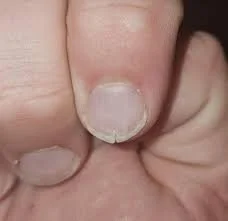
I am not keeping up with my prose poem writing. I was trying to at least start a new one every day, but I’ve been preoccupied. My sister is temporarily in rehab (a long and very difficult story), Jerry is having a series of five radiation treatments for a spot on his lung which may or may not be malignant, but probably is. He’s very shaky, can barely shuffle along with the walker or cane, and isnot feeling so good. And surprise! my own x-rays have revealed a spot on my OWN lung which, after a Pet scan this Friday, may need further treatment. Good lord! But the writings, even this blog, are deeply nourishing. One of the questions that came up in yesterday’s Zoom was “what’s the difference between pouring out your woes on paper and making art?”
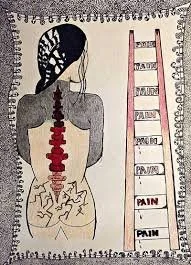
Pain, for sure.
It’s a matter of intention, mostly. And distance, in a sense. Not holding the pain close, using it to show how beleaguered you are, how brave you’re being, but keeping in mind the audience and wanting to make something beautiful on paper. Beauty doesn’t mean charming or pleasing, necessarily. I would say beauty is inexplicable. Can you not love someone with a crooked nose?
Yesterday our art class watched the second part of a documentary on Louise Bourgeois, the sculptor. So much of her work is not pretty. She made rusty towers with small objects inside. She drew boxes on paper. She was an emotional volcano. Finally she found the Granddaddy Long Legs as a subject. Here I begin to love her! I love those creatures. There is a huge one in front of the Guggenheim Museum that she made. But the point is, her art was/is a matter of intention. She meant to make art, to hell if you didn’t like it.
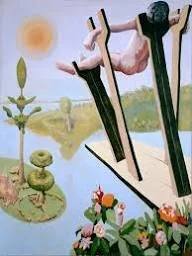
Renee Magritte, about disaster?
Think of the dazzling poems about disaster. Think of “Failing and Flying” by Jack Gilbert; Franny Choi's "Disaster Means ‘Without a Star’" (look it up) think of “Dreams” by Langston Hughes, “Icarus” by William Carlos Williams; think of Muriel Rukeyser’s
One Art;” think of any number of poems by Lucille Clifton. In fact, most poems have something painful or difficult in them. That’s what got them written, right? But the shape of them, the loving handling of the suffering, can be beautiful. Not only beauty is beautiful. You can quote me.
It’s day-by-day here. Trouble/pain causes a slowing down. An awareness of where you are at this moment. An awareness that “nothing gold can stay,” as Frost says. Which means that in a sense, there’s always disaster, things always ending. But there are things always beginning, too. No sense trying to balance the bad with the good. They’re both there, all the time.
The P.S. . . . Please join the wonderful poet Kathleen McGookey and me for “The Pleasures and Possibilities of the Prose Poem,” April 16, 7:00 p.m. with Michigan Writers on ZOOM. Anne Marie Oomen will host.